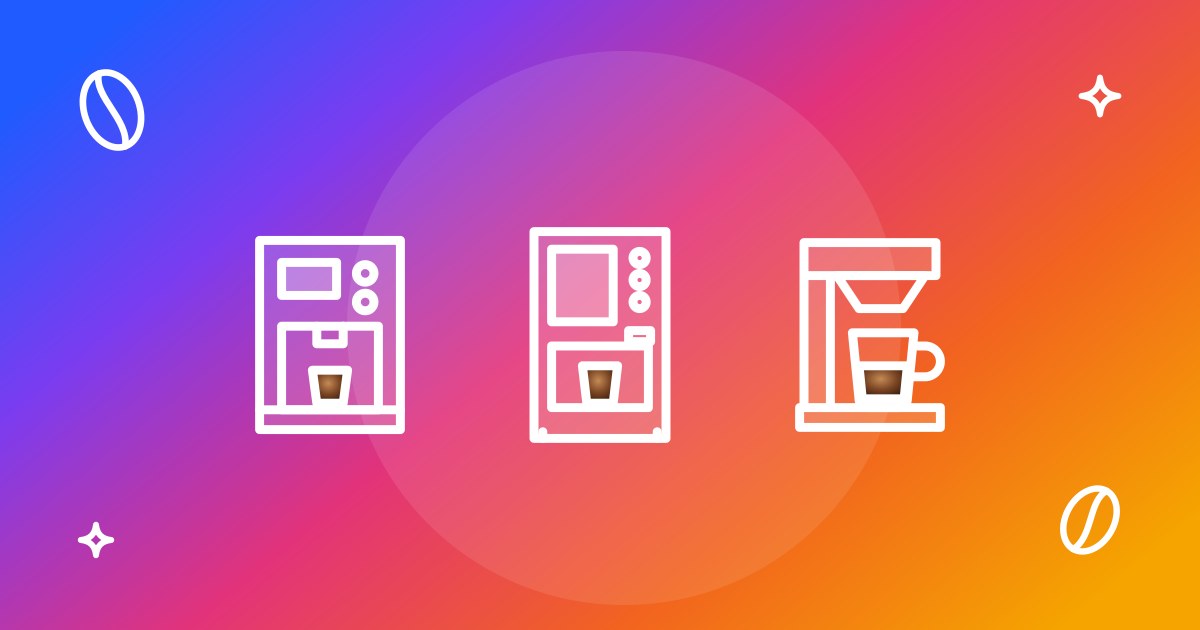
Espresso machine, coffee vending machine, or drip brewer? We compare three ways to serve office coffee: upkeep, drink choice, cleaning, and team fit.
- Start with your team, not the machine
- Drip brewers and moka pots
- Espresso machines
- Coffee vending machines
- Who does the work?
- Costs beyond the price tag
- Space, water, and power
- Variety and taste
- Peaks and queues
- Combining options
- Questions to ask before you decide
- The best option is the one that gets looked after
- FAQ
Every office coffee debate eventually reaches the same moment. Someone says, "Why don't we just get a proper espresso machine?" Someone else remembers the last one, which died after the third descaling nobody did. A third person quietly suggests a simple drip brewer, and is ignored. The truth is that there is no single best option. The right choice depends on how many people drink coffee, when they take breaks, and, above all, who is going to look after the equipment. This post compares the three most common setups for companies: a drip brewer or moka pot, an espresso machine, and a coffee vending machine serviced by an operator. It looks at what each one does well, what it asks of your team, and which questions help you decide. We do not know your office, so treat this as a map, not a verdict.
Start with your team, not the machine
Before comparing equipment, look at the people who will use it. How many of them drink coffee or tea? Do they arrive at the same time and want coffee at nine, or are breaks spread through the day? Does the office run shifts, weekends, or evening work? Do most people drink black coffee, or are milk drinks popular? Is there someone willing to look after a machine, or does everyone already have a full plate? These answers matter more than any feature list. A small team that drinks filter coffee at fixed times needs something very different from a large office where people want cappuccinos at all hours. Write the answers down before you look at a single product page. It will save you from buying for the office you imagine instead of the one you have.
Drip brewers and moka pots
A drip brewer or a moka pot is the simplest option and usually the cheapest to buy. It makes a pot of coffee that several people can share, which suits teams that drink similar coffee at similar times. There are few parts to break, and most people already know how to use one. The catch is that someone has to do the work. A person must brew regularly, wash the carafe, throw away old coffee, and keep filters and beans or ground coffee in stock. Coffee left on a warming plate for hours tends to taste worse as the day goes on. Drip brewers also offer little variety. If your team mostly wants plain black coffee and someone is happy to look after it, this can be a perfectly good choice. If people want milk drinks or different strengths, it may feel limiting.
Espresso machines
An espresso machine, especially a bean-to-cup model, offers more choice. Many can make espresso, longer black coffees, and drinks with milk at the press of a button. Fresh grinding usually gives a better aroma than pre-ground coffee kept in a cupboard. For many offices, this feels like a real upgrade. But an espresso machine asks for more care. It needs regular cleaning, emptying of the grounds container and drip tray, refilling of beans and water, cleaning of the milk system, and descaling. How often each task is needed, and how to do it, is set out in the manual. If nobody does these jobs, the coffee suffers first and the machine later. The most important step happens before the machine arrives: agree on who is responsible.
Coffee vending machines
A coffee vending machine prepares a drink after a selection on the panel. Depending on the model, it may offer several coffee styles, tea, hot chocolate, and other hot drinks. The big difference is usually who looks after it. In many arrangements, an operator handles upkeep, cleaning, restocking, and repairs. Employees simply choose and drink. A coffee vending machine works well where breaks are spread throughout the day and where nobody in the office wants to own the coffee setup. What the machine offers, how often it is serviced, and how payment works depend on the model and the operator's terms, so ask rather than assume. Some offices pay for drinks centrally, while others let employees pay per cup.
Who does the work?
This is the question that decides most comparisons. With a drip brewer, the work is small but daily, and it falls on whoever is in the kitchen. With an espresso machine, the work is larger and more technical, and it needs a clear owner or a rota. With an operator-serviced vending machine, most of the work moves outside the team. None of these is right or wrong. Some teams enjoy looking after their own machine, and someone takes pride in a well-kept espresso maker. Other teams are stretched, and every extra task becomes a source of friction. Be honest about which kind of team you are. A machine that needs care in an office where nobody has time is a recipe for that familiar note on the kitchen wall asking someone, anyone, to descale it.
Costs beyond the price tag
The purchase price is only one part of the cost. A drip brewer is cheap to buy, but someone spends time brewing and cleaning every day. An espresso machine costs more upfront and needs beans, milk, cleaning products, descaling, and occasional servicing or repairs. A serviced vending machine often comes with an agreement that covers the machine, its upkeep, and sometimes the supplies, with costs that depend on the operator's terms. Comparing these options fairly means looking at the whole picture: equipment, supplies, maintenance, repairs, and staff time. Ask each supplier for a clear breakdown based on your actual use. For questions about how to book these costs, ask your accountant. Do not compare a purchase price with a monthly fee and assume the lower number wins.
Space, water, and power
Each option needs a suitable spot. A drip brewer needs a counter, a socket, and access to water for filling and washing. An espresso machine may need more counter space, easy access to water or a direct connection, and a place for cleaning. A vending machine is usually freestanding and needs floor space, a suitable socket, and room for people to stand in front of it. The electrical requirements for any machine are on its rating plate and in its manual. If you are not sure whether a socket or circuit is suitable, ask an electrician. Think about noise too. Grinders and vending machines can be loud. A kitchen or break area usually works better than a corner of an open-plan office where people take calls.
Variety and taste
Teams rarely agree on coffee. Some people want a strong espresso, others a large mild coffee, others only tea or hot chocolate. A drip brewer usually makes one kind of coffee at a time. An espresso machine offers more options, especially if it handles milk. A coffee vending machine often has the widest menu, depending on the model. Taste also depends on the coffee itself, the water, and how well the equipment is maintained. A well-kept drip brewer with good coffee can beat a neglected espresso machine. If people need plant-based milk or have allergies, check what each option can offer, and point people to the product label or the supplier for ingredient details. Asking the team what they actually drink is the best starting point.
Peaks and queues
Think about the busiest moment of your day. In many offices, it is the first half hour after people arrive, or the minutes after a long meeting. A drip brewer can serve several people quickly from one pot, as long as someone brewed it in time. An espresso machine makes one drink at a time, and a queue can form when everyone arrives together. A vending machine also serves one drink at a time, but it is often built for heavier use. Look at the manufacturer's information on what kind of daily use a machine is designed for, and compare it with your own numbers. If your peaks are sharp, a second machine or a mix of options may work better than one large unit.
Combining options
You do not have to pick just one. Some companies have a vending machine in a shared area for everyday use and a simple brewer in the conference room for meetings. Others keep an espresso machine for a small team on one floor and a vending machine near the entrance for visitors and other departments. Mixing options can solve different needs at once, but it also adds more equipment to look after. If you combine setups, be clear about who is responsible for each one. The vending machine may be the operator's job, while the meeting room brewer stays with the office manager. Write this down, so nobody assumes someone else is taking care of it.
Questions to ask before you decide
Use this short list to guide the decision.
- How many people drink coffee or tea, and when?
- Who will clean, refill, and descale the equipment?
- Which drinks does the team actually want?
- What space, water, and power are available?
- What are the full costs, not just the purchase price?
- What happens when something breaks, and who fixes it?
- Would a mix of options serve the team better?
Answer these honestly, and the right option usually becomes clear.
The best option is the one that gets looked after
In the end, the best office coffee setup is not the most expensive or the most impressive. It is the one that fits your team and actually gets looked after. A simple brewer that someone cares for can serve a small team well for years. An espresso machine can be a joy, if it has a clear owner. A serviced vending machine can take the work off your team entirely. Start with how your people drink coffee, be honest about who will do the work, and choose from there.
Related reading: Coffee for Visitors at Reception.
FAQ
Which option requires the least work from the team? Usually an operator-serviced vending machine, since cleaning and restocking do not fall on employees.
Can you combine options? Yes. Some companies have a vending machine in a shared area and a simple brewer in the conference room.
Is an espresso machine better than a drip brewer? Not always. It offers more drinks but needs more care. A well-kept drip brewer can suit a small team well.
How do we choose between them? Start with headcount, break patterns, and who will look after the equipment. Then compare full costs.